4 Ways to Support Your New Teachers

Anyone who has been in and around education over the last twenty years or more can attest to the decreasing number of qualified teachers seeking jobs amid the increasing number of teaching vacancies. Teachers leave one school district for another, or they leave the profession, for various personal and professional reasons. As districts all over the United States see the applicant pool dwindle for their respective positions, more are becoming laser-focused on perhaps their greatest asset, the beginning teacher.


3 Areas to Consider When Creating A Positive School Culture

“Nothing frustrates a good teacher more than the district hanging on to a bad one,” an educator commented to me recently. While true, this is a problem that is not going away anytime soon. Since the pandemic, teaching has suffered as a profession. Too much negativity from one or more teachers can quickly spread to others if not addressed. However, with the nationwide teacher shortage, a certified teacher, even a poor one, seems preferable to a long-term substitute, even though the culture of the building or potentially, the entire school district may suffer.

Unfinished Business: A Different Peer Review Strategy

Every rose has its thorn This strategy is based on Liz Lerman's Critical Response Process, which has amazing potential even outside of its intended use. After reading her book on this process, I have been pondering ways to use this model with students of all ages, and with some restructuring according to the age or … Continue reading Unfinished Business: A Different Peer Review Strategy

Two AI Platforms With Power & Educational Potential: Plag and DallᐧE

While ChatGPT (see previous post) has taken the world by storm, and truly set fire to education, there are other artificial intelligence (AI) platforms that can also impact education. While there are always going to be negatives associated to these latest developments, there are also significant positives if you look for them. Critical thinking is a very important skill to develop in our students and teaching them how to use AI to enhance rather than replace it is crucial. Before we rush to ban all of the AI platforms and websites that are emerging, educators should dive in and explore the possibilities. The two I am going to explore have benefits for both teachers and students.

Let Us Re-Think

The field of education, particularly here in America, is going through a crisis that doesn't seem to be near a solution any time soon. Both new and experienced educators are leaving the field. School districts are finding bandaids to stop the hemorrhaging instead of more effective treatments. Long term subs, some barely out of high school, and others without degrees or education training are now teaching students in order to fill positions. Horror stories about what a teacher has said or done to students in their care are becoming more and more publicized and prevalent. Okay, so I have identified the problem. Great. Now what can we do?

Quickwrites Are For All

Ever find yourself looking for a quick activity that has value for your learners but doesn't require a lot of prep or extra work on your part? I think most educators find themselves in this position occasionally, whether it is an activity to kick off the class period, the learning session, or the conference workshop. A powerful but often overlooked tool in our arsenal is the quickwrite. Some of you are already thinking, that's great, but I don't teach English. I know, but the quickwrite is a flexible tool that all subjects, except maybe physical education (PE) and fitness/conditioning, can use daily, weekly, or periodically.

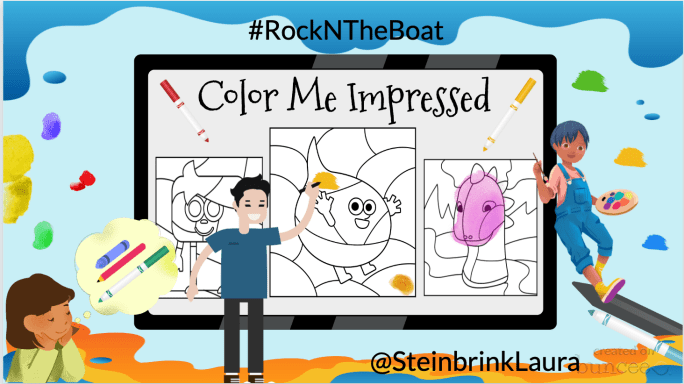
Color Me Impressed

As I prepared my room for the new school year back in August, I did a lot of thinking about the hallway bulletin board that is under my control. I hate doing bulletin boards, generally speaking. In this post, I walk through the process of creating an interactive bulletin board for students to color.

Creativity: A Skill We All Need to Foster and Protect

Believe it or not, and I am constantly surprised by the number of educators who don't believe it, the research is clear on all of the ways that students' success, creativity, and growth are harmed by extrinsic motivators. This leaves many educators, including my research partner, Kristy Graber, and me, searching for ways to eliminate rewards while equipping students with the gear needed to strengthen these areas. This can be especially challenging considering how prevalent rewards are in daily life. Here is the last portion of our research paper that I have condensed into a blog post.

Everyone Needs a Throwing Partner

My son Ryan plays travel baseball and high school baseball, and he is fortunate to get to play both of those with his cousin Hayden. They are three weeks apart in age, so they naturally get to do a lot of things together. However, having the same throwing partner for both the travel team and the high school team is pretty cool. Your throwing partner is important, so having the right one is crucial.

Classroom Community Building

Relationships between students and their teachers are important, but so are the relationships built in class between classmates. While pacing guides and other curriculum demands can become overwhelming fast, there are some easy ways to work in relationship building too. New students popping in throughout the school should definitely be a reminder to add team building or relationship building into your plans, but the truth is that all students benefit with regular or periodic activities that help them get to know their classmates.