
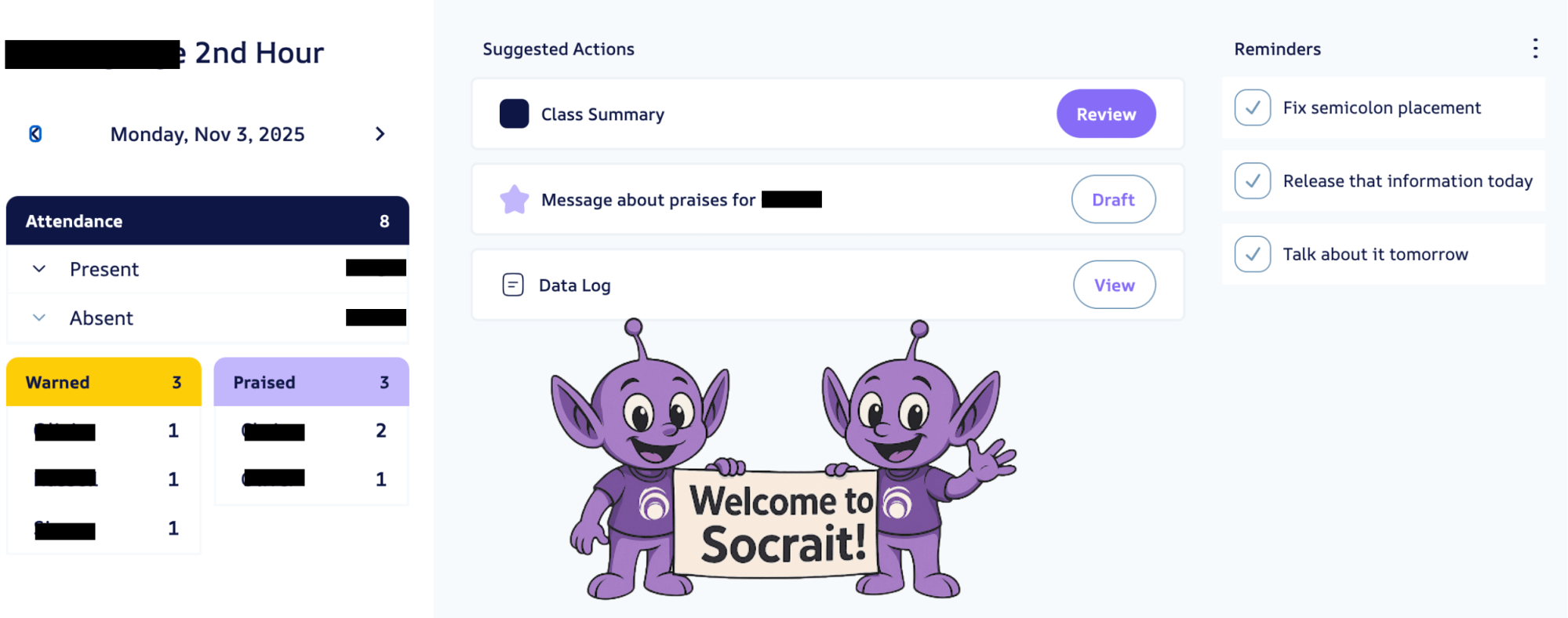
It has been a while since I have posted, but I have been recovering from a concussion in April and unfortunately, I have post-concussion syndrome, which is still an issue. However, that hasn’t stopped me from exploring AI tools that can help shrink the growing tasks piled onto teachers’ plates, so let me introduce you to Socrait. This app does a lot, but in this post, I am focused on one particular aspect that can greatly improve your classroom management and your relationships with students. All of that will impact student learning and success, so let’s get to it.
You’re wondering who I am
First, it is an app and a website. So I created an account on the website and I downloaded the app onto my phone. I created a class to try it out with, and I entered just the first name or name I call the student in class. Then, before class starts or when I remember toward the beginning of class, I pull my phone out of my pocket, open the app, sign in with Google, select that class, and click the purple start button. When class ends, I pull out my phone and click the same button to end the session. The AI in the app is listening to me and transcribing what I say, and it does some amazing things with that information, which I access via the website, but we for today’s post, will focus on a specific way it helps teachers: the praise and redirect tally count.
Machine or mannequin?
The Socrait app helps improve my teaching practice is by showing me the daily data on how many praises & redirects I give students in a class period. If the redirects outnumber the positive interactions, I have some adjusting to do. I used to have to find ways to track this with paperclips, sticky notes or popsicle sticks. Socrait transcribes what I, the teacher to generate data on my teacher interactions, including a daily tally of praises versus redirects to promote balanced classroom management. This is my goal, though I don’t always achieve it, but if I am using data daily to work on this goal, it is much more achievable.
With parts made in Japan
Why do I care about my positive to negative daily interactions with students? I work hard on the overall culture of my classroom and the individual relationships I have with students. I don’t always succeed with all of them, but I do make the effort. As it turns out, research confirms that it matters a lot. A second-order meta-analysis reviewing over 26 prior meta-analyses and more than 70 years of research on teacher–student relationships (TSRs) showed a positive correlation between TSRs and crucial student outcomes, such as academic achievement, emotions, motivation, and appropriate behavior (Emslander et al., 2025). That is a lot of research in support of positive feedback to students outweighing the negative. Surprisingly, or maybe not, this isn’t generally covered in teacher education programs. To do this with fidelity, we need to track our interactions, and therein lies the challenge, for me, at least.
I am the modern man
How do teachers usually track these interactions? If you are now or ever have been a PBIS teacher, then likely you have used paper clips or something in your pocket, popsicle sticks, or a simple tally on a sticky note or phone app during lessons. Maybe you’ve set a timer for 3-minute intervals as a reminder to praise a student. Let’s be real. I’m doing well on the daily to have my classroom keys in my pocket, much less paper clips or popsicle sticks. My phone, however, I seem to remember.
I’m not a robot without emotions, I’m not what you see
Generally speaking, the 4:1 praise-to-redirect ratio is a widely recommended guideline in education and behavioral science for fostering a positive classroom environment. Moyer (2014) found that “While no specific ratio is explicitly supported by research, research
does indicate there should be more positive than negative feedback.” Logically, this makes sense, but it is impossible to accurately track that by just doing it mentally. Those familiar with PBIS (Positive Behavior Interventions and Support) research suggests that teachers should deliver four positive statements or praises for every one corrective statement or redirect. Yes, this approach draws from Positive Behavioral Interventions and Supports (PBIS) frameworks and aims to build stronger teacher-student relationships, boost engagement, and reduce disruptive behaviors by emphasizing reinforcement over criticism. Don’t come at me, if you are not a fan of PBIS. I am not promoting PBIS. I have read Alfie Kohn’s Punished By Rewards: Twenty-Fifth Anniversary Edition: The Trouble with Gold Stars, Incentive Plans, A’s, Praise, and Other Bribes and highly encourage every educator to read it. That being said, there are golden nuggets in PBIS that I do appreciate. This is one. If you are a PBIS fan, then you will appreciate this as well.
I’ve come to help you with your problems so we can be free
Why 4:1? Like Moyer mentioned (2014), the ratio isn’t a strict “magic number” but is backed by studies showing that higher positive-to-negative interactions improve outcomes. For instance, an analysis from the IRIS Center, (n.d.) Vanderbilt’s Peabody College, highlights praise as a tool to enhance social and academic performance, with a 4:1 balance tipping the scale toward encouragement. Similarly, Caldarella et al. (2020) found a positive linear relationship: as teachers’ praise-to-reprimand ratios increased, elementary students’ on-task behavior rose steadily; no sharp threshold like exactly 4:1 was needed, but the direction mattered. This alone is a great indicator of where behavior management should be moving, and we’ve had this data for some time. We know it works, but it is not embedded like it should be in our prep programs, and with the national teacher shortage, many schools have to fill teaching positions with teachers who did not even go through a prep program but were certified through an alternate route. Socrait can help everyone attain this goal and classroom balance.
I’m not a hero, I’m not the saviour, forget what you know
I strive for at least a 3-1 balance, and with Socrait in my pocket, I believe I finally have a way to accurately keep track. I still fail during the business of a class period to focus on positive feedback, but I reflect and do better. Adopting 4:1 or even 3:1 can transform classroom dynamics with minimal effort. Start small, and you’ll likely see quicker acquiescence and happier interactions. I personally discovered that my negative feelings toward some students changed dramatically. It can be really hard to find a positive comment or feedback, but do try. Also, if you’re experimenting with Socrait, it could provide real-time data to refine your ratio. I strongly encourage you to give it a try.
Shameless plug:
🔥Freebie alert! If you haven’t tried Socrait yet, sign up/get a demo to try Socrait, mention my name, & you’ll get a free ☕️Starbucks gift card!
References
Caldarella, P., Larsen, R. A. A., Williams, L., Downs, K. R., Wills, H. P., & Wehby, J. H. (2020). Effects of teachers’ praise-to-reprimand ratios on elementary students’ on-task behaviour. Educational Psychology, 40(10), 1306–1322. https://doi.org/10.1080/01443410.2020.1711872
Emslander, V., Holzberger, D., Ofstad, S. B., Fischbach, A., & Scherer, R. (2025). Teacher–student relationships and student outcomes: A systematic second-order meta-analytic review. Psychological Bulletin, 151(3), 365–397. https://doi.org/10.1037/bul0000461
IRIS Center. (n.d.). Page 2: Behavior-specific praise. Vanderbilt University. https://iris.peabody.vanderbilt.edu/module/bi2-elem/cresource/q1/p02/
Moyer, K. (2014, June 30). Zooming in on classroom management in the Teacher Prep Review. National Council on Teacher Quality. https://www.nctq.org/research-insights/zooming-in-on-classroom-management-in-the-teacher-prep-review/
 #RocknTheBoat